
Last updated: November 16, 2026
Body feminization surgery MTF is an individualized approach to reshaping the waist, hips, and buttocks to better reflect a person’s contour goals. For some transfeminine adults, that means softening a square torso or adding curves; for others, it means making a smaller change that feels more like their own body.
What Is Body Feminization Surgery MTF?
Body feminization surgery MTF refers to surgical body contouring planned around a transfeminine person’s goals, often focusing on the waist, hips, or buttocks. A plan may address a thick waist, narrow hips, or flat buttocks, but no procedure or set of proportions defines a feminine body. Our options can also include breast augmentation with implants or fat grafting when breast volume is among your goals.
“MTF” is a common search term, not a label every patient uses for themselves. At La Belle Vie Cosmetics, the useful starting point is the shape you want to explore, not an assumed ideal. Our body feminization surgery service offers a place to begin that conversation.
Which body proportions can these procedures change?
Body contouring can change the visible relationship between the torso, waist, hips, and buttocks. Reducing fullness around the midsection may make the waist appear more defined, while adding volume in selected areas may create a rounder outline. Your underlying anatomy still influences the result. The goal is a plan suited to your body, rather than a promise to reproduce someone else’s proportions.
What is feminization surgery?
Feminization surgery is an umbrella term for procedures chosen to better align a person’s appearance with their gender identity. As the Mayo Clinic overview of feminizing surgery explains, options can involve the chest, face, body contours, or genitals. A person may choose some procedures, one procedure, or none; body contouring does not require genital surgery.
What is an MTF female?
“MTF” means “male-to-female,” an older term some people use for a transgender woman: a woman who was assigned male at birth. Not every trans woman uses that label, and some people seeking body feminization are nonbinary.
Can you get erect after gender reassignment surgery?
Body feminization surgery does not directly change penile erectile anatomy, whereas penile erections are no longer possible after penile-inversion vaginoplasty. Feminizing hormone therapy can affect sexual function, and sexual sensation and function after vaginoplasty vary between patients.
How Can Surgery Change the Waist, Hips, and Buttocks?
Surgery can change body contours by removing fat from selected areas, adding volume where appropriate, or combining those approaches. Liposuction may refine the waist and torso, while fat transfer may add fullness to the hips or buttocks. For someone researching hip feminization surgery, fat transfer can add soft-tissue fullness around the outer hips but cannot widen the pelvic bones. Donor fat, skin quality, anatomy, and personal goals determine which possibilities merit discussion.
These MTF body contouring options change different areas and have different limits:
| Option | What it can change | Key limit |
|---|---|---|
| Liposuction | Removes localized fat to define the waist or torso. | Does not change pelvic bones or reliably tighten loose skin. |
| Fat transfer to the hips or buttocks | Adds volume using fat removed from another area. | Requires suitable donor fat; the volume that can be added varies by patient. |
| Breast augmentation with implants or fat grafting | Adds breast volume rather than changing the waist or hips. | Fat grafting requires suitable donor fat; implants and grafting involve different surgical considerations. |
Fat transfer uses fat removed from one area to add volume in another. A 2024 systematic review of gender-affirming body contouring reported that 8% of patients who underwent large-volume fat grafting were dissatisfied because of fat reabsorption. That finding does not predict how much of an individual patient’s transferred fat will remain.
How can liposuction change waist and torso contours?
Liposuction removes localized fat beneath the skin. Around the waist or torso, that may create more definition, but it does not narrow bone or reliably tighten loose skin.
Who Might Be a Candidate for Body Feminization Surgery?
A potential candidate wants more feminine body contours, is in good overall health, maintains a stable weight, and has realistic expectations about results and recovery. Your anatomy, medical history, and goals—not a particular starting body shape or whether you take hormone therapy—guide Dr. Mangubat’s assessment of whether and when surgery is appropriate. A medical condition that makes one technique unsuitable, or insufficient donor fat for grafting, does not necessarily rule out every body-contouring option.
Feminizing hormone therapy can change fat distribution, but those changes differ from person to person; it can be used with or without surgery. Some people seek body feminization after years of noticing a lack of curves; others want to explore whether a specific area can be refined. Neither experience points automatically to liposuction, fat transfer, or a combined plan.
How do anatomy and donor fat affect candidacy?
A surgeon considers where fullness is located, how the skin may respond to contour changes, and whether fat could be taken from a suitable area if transfer is being discussed. Available donor fat can limit how much volume might be added. Prior procedures, medical conditions, and personal priorities matter too. Limited donor fat or substantial loose skin may make fat transfer alone insufficient for the change you want.
What Happens When You Plan Body Feminization Surgery?
Planning body feminization surgery starts with your goals and a clinical assessment of your body and health. A plan may include liposuction, fat grafting, breast augmentation, or a combination. Some procedures can be combined in one operation; others may be staged when a single operation would be too extensive. Travel, recovery help, and follow-up also belong in the plan.

Clear examples of what you like about certain contours can help you describe your goals without committing to a particular technique. At La Belle Vie Cosmetics, Dr. Tony Mangubat tailors each surgical plan to your goals and anatomy. We explain the expected limits of treatment and discuss what a satisfying change would mean to you.
How are your contour goals translated into a procedure plan?
Dr. Mangubat may propose liposuction for localized waist fullness, fat transfer when you want added hip or buttock volume and have suitable donor fat, or breast augmentation when breast volume is a goal. Whether to combine procedures depends on your health and the scope of the proposed surgery. If your plan combines liposuction and lower-body fat transfer, the steps are:
- The waist, hips, buttocks, skin, and possible donor areas are assessed to plan the contour changes.
- Under general anesthesia, liposuction removes fat from selected areas, such as the abdomen, flanks, or waist.
- Suitable fat is prepared and transferred to planned areas, which may include the hips, thighs, or buttocks.
- You recover at our accredited surgical facility before going home, typically the same day or after a brief recovery period.
Breast augmentation follows a different plan. For implant augmentation, a surgeon makes an incision around the areola, near the armpit, or in the crease beneath the breast and places a saline or silicone implant beneath the breast tissue. Breast fat grafting instead involves removing fat from a donor area, preparing it, and transferring it to the breasts. The liposuction-and-lower-body-transfer sequence above does not describe every breast procedure.
Depending on your personalized plan, surgery can take several hours; most procedures are completed in a single session. If you are coming from Renton or elsewhere in the Seattle area, our office is at 16400 Southcenter Pkwy, Suite 101, Tukwila, WA 98188; arrange a ride, help at home, and access to follow-up.

What does recovery and aftercare involve?
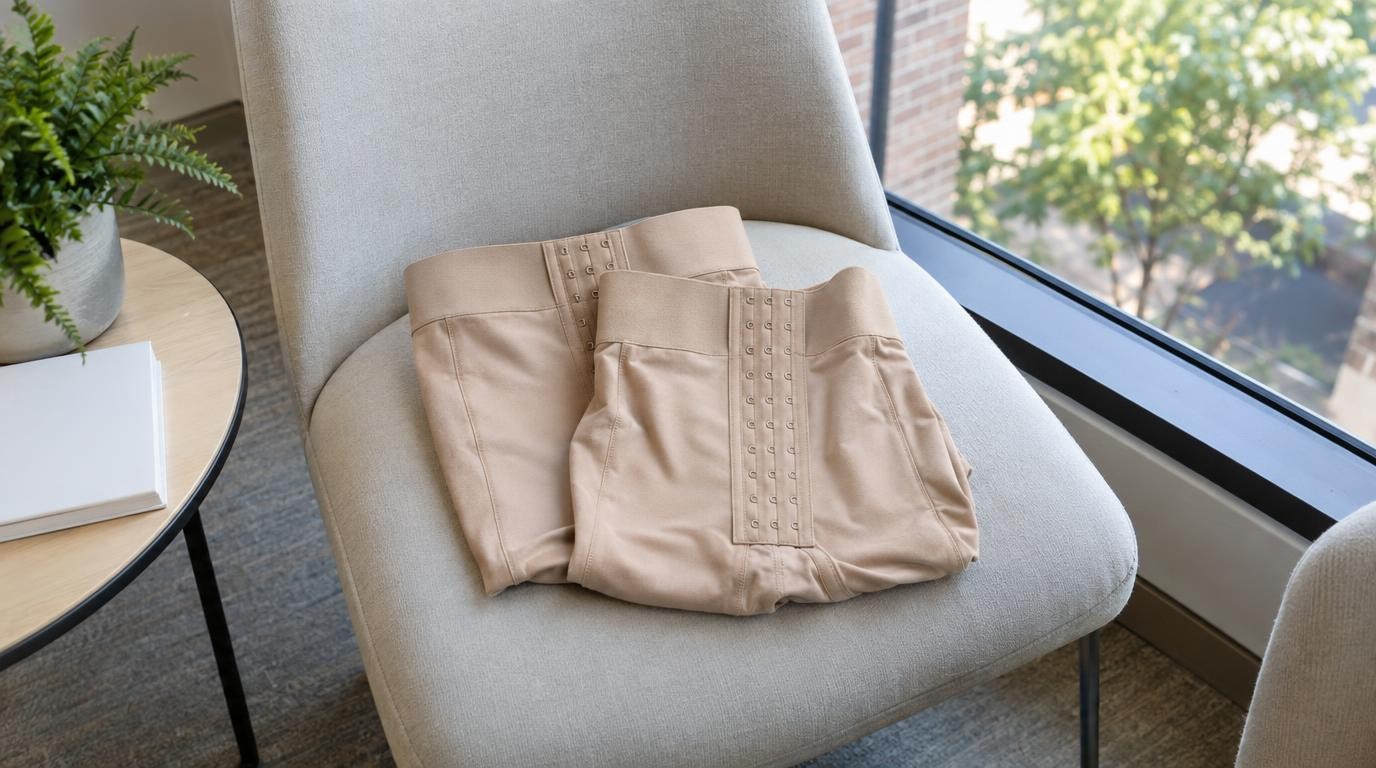
After surgery, you will wear a compression garment to help manage swelling and support your new contours. Swelling and soreness are common during the first week and gradually subside. Many patients resume light activities within 10–14 days and normal routines within four to six weeks, although recovery varies with the procedures performed and individual healing.
Risks, Side Effects and Who Is Not a Candidate
Swelling, bruising, and soreness are common after body feminization surgery; temporary changes in sensation can also occur. Less common but more serious complications include bleeding, infection, fluid buildup, poor healing, and blood clots, including deep vein thrombosis and pulmonary embolism. Uneven contours or persistent sensation changes are possible. Buttock fat transfer also carries a rare risk of life-threatening fat embolism if fat enters a large vein; grafted fat should be placed in the tissue above the gluteal muscle, not in the muscle. If your plan includes breast implants, risks include capsular contracture (scar tissue tightening around an implant), implant rupture, and the possibility of further surgery.
A 2026 retrospective study of hybrid body feminization surgery found three blood clots among 52 patients (5.7%) despite drug-based and mechanical clot prevention: two asymptomatic deep vein thromboses (3.8%) detected through Doppler ultrasound surveillance scheduled on postoperative days 1, 3, 7, and 10, and one symptomatic pulmonary embolism (1.9%) after early long-haul travel. These are findings from one series of complex, combined operations, not the expected complication rate for every body-feminization plan. Your risks depend on the procedures, techniques, and your health.
Contact our clinic promptly for fever, increasing redness, drainage, or worsening pain after surgery. Seek emergency care for chest pain, sudden shortness of breath, fainting, or new painful swelling in one leg.
Someone with an active infection at a planned surgical site or a medical condition that makes anesthesia unsafe should not proceed with elective surgery unless a clinician determines the concern has been resolved. A person unable to arrange essential postoperative support may need to defer surgery as well. These are reasons for careful assessment, not a substitute for personal medical advice. Discuss your health history, medications, clot risk, the proposed technique, and procedure-specific risks with your own clinician before deciding.
How Can You Decide Whether Body Feminization Surgery Fits Your Goals?
Waist contouring and added hip or buttock volume are possibilities, not outcomes to assume. A 2022 systematic literature review of longer-term outcomes after gender-affirming surgery found that most patients in the studies it examined reported satisfaction at least one year after surgery. The 79 studies were generally low-quality and concerned chest, genital, facial, voice, and Adam’s apple procedures, so their findings cannot predict an individual’s body-contouring result. Weigh your desired change against the limits of surgery, its risks, and the recovery you can manage.
You can choose not to have surgery. If you want feminizing hormone therapy and it is medically appropriate for you, it can be used without surgery. When donor fat is limited, some surgeons use lower-body implants in selected cases. Implants add volume without donor fat but have risks of displacement, exposure, and rupture; the 2024 systematic review of gender-affirming body contouring reported two gluteal implant displacements, one exposure, and one rupture in the lower-body studies it examined.
If you are considering body feminization surgery in Renton or nearby, contact La Belle Vie Cosmetics in the Seattle area to request a consultation with Dr. Tony Mangubat. We welcome the chance to hear what you hope to change and help you explore an appropriate path forward.
Frequently Asked Questions
Could a tummy tuck or thigh lift help if I have loose skin?
If loose skin is a major concern, a tummy tuck or thigh lift may be more useful for that concern than liposuction alone: these procedures remove excess skin, whereas liposuction does not reliably tighten it. Both require incisions and have their own recovery considerations; an extensive combination of procedures may need to be staged.
Should I stop hormone therapy or other medications before surgery?
Do not stop prescribed hormones or other medications on your own. Bring a current list of medications and supplements to your consultation. Dr. Mangubat can review it with you and coordinate with your prescribing clinicians if changes are needed for your procedure and health.
What if I have childcare or caregiving duties during recovery?
Arrange help with lifting and other physically demanding caregiving tasks after surgery. Ask our team which movement and lifting limits apply to your plan; being ready for light activities does not necessarily mean it is safe to lift a child or resume strenuous caregiving.
How should I arrange follow-up if I travel for surgery?
Arrange postoperative visits before booking your return trip, and avoid early long-haul travel after complex surgery: prolonged immobility can add to blood-clot risk. There is no single safe travel day for every operation, so plan your departure around the recovery and follow-up schedule for your procedures. Keep our contact information and a plan for local urgent or emergency care if symptoms develop while you are away.
What results can I realistically expect from body feminization surgery?
Expect an individualized contour change, not a guaranteed body shape or exact proportion. Waist liposuction may improve definition, while added hip or buttock volume may create a rounder outline. Your anatomy, skin quality, and available donor fat influence what is achievable. Early swelling can obscure the result; you can assess your contours more clearly as healing progresses. Established contours can be long-lasting, but later weight changes can alter their appearance.
Does smoking or vaping affect my surgical plan?
Nicotine from cigarettes or vaping can impair blood flow and wound healing. Tell us about tobacco, nicotine products, and any recent use; switching from cigarettes to nicotine vaping does not remove this healing risk. Nicotine use may mean postponing surgery until you can stop for the period required before and after your procedure.
What are some common facial feminization procedures?
Common options include forehead contouring, hairline advancement, a brow lift, rhinoplasty, cheek enhancement, lip reshaping, and chin or jaw contouring, according to the American Society of Plastic Surgeons’ overview of facial feminization surgery. A tracheal shave may also be included. Facial feminization addresses different anatomy from body contouring; no one needs every procedure.
Does insurance cover MTF bottom surgery?
Coverage for transfeminine bottom surgery depends on the procedure and your insurance plan. The American Society of Plastic Surgeons notes that coverage may be limited; ask your insurer which procedures are covered and what requirements apply. Bottom surgery is separate from body feminization surgery.
How do you pee after bottom surgery MTF?
After orchiectomy alone, you still urinate through your original urethral opening; after vaginoplasty, a catheter drains urine for several days before you urinate through a urethral opening in the vulva, generally while seated. Difficulty urinating after surgery needs medical attention.
How painful is MTF bottom surgery?
After vaginoplasty, pain and swelling are expected, but their severity varies and postoperative pain control is part of care. The Mayo Clinic notes that close monitoring may last about a week and recovery can take up to two months. New, severe, or worsening pain needs prompt assessment.
This information is general and is not medical advice. Talk to a licensed clinician about your own situation before making a treatment decision.
