

Last updated: October 21, 2026
At La Belle Vie Cosmetics, most patients resume light activities within 10-14 days of thigh lift surgery and return to exercise in about six weeks. Those are planning estimates, not clearance dates: swelling and refinement can continue for months after your usual activities resume.
How long is recovery time for a thigh lift?
At La Belle Vie Cosmetics, most patients return to light activities within 10–14 days and exercise in about six weeks. Those are activity milestones, not the end of healing: Cleveland Clinic says most people make a full recovery within six months, when swelling should have resolved. Your timeline depends on the procedure and how you heal. The American Society of Plastic Surgeons thigh lift recovery guide distinguishes a gradual return to daily activities from a later return to exercise.
Plan for the greatest disruption early on, followed by a gradual return to your routine. The American Society of Plastic Surgeons guide outlines these stages:
- Week one: Monitor pain, swelling, and bruising, and wear a compression garment.
- Weeks two to three: Limit exercise and other activities.
- Weeks four to five: Return to normal daily activities, but avoid heavy lifting and exercise.
- Week six and beyond: Return to normal activities, including exercise.
Your incision healing, comfort, and surgeon’s instructions determine what you can safely do at each stage.
What should you plan for immediately after a thigh lift?
Immediately after a thigh lift, plan to rest and have someone drive you home. Sore thighs can make household movement difficult at first. An article on the American Society of Plastic Surgeons website recommends having someone with you for the first few days, arranging rides to your first couple of follow-up visits, and making food and a bathroom easy to reach. Cleveland Clinic recommends resting your legs as much as possible for up to 10 days and staying home from work or school during that period.
Set up a comfortable place to recover before surgery, and avoid unnecessary stair trips if movement is difficult. Rest does not mean remaining completely immobile: follow your operating surgeon’s specific instructions about getting up, walking, and positioning your legs.
What happens during the first two weeks of thigh lift recovery?
Early thigh lift recovery calls for help and flexibility. At La Belle Vie Cosmetics, we expect bruising, swelling, tightness, and discomfort during this period; prescribed medication may help manage discomfort. Incision care and activity limits still matter even when you feel able to do light tasks.
Your incisions will be covered with bandages or dressings, and temporary drains may be placed to remove excess fluid or blood. Your aftercare instructions will cover incision and drain care, medications, and follow-up visits.
How painful is a leg lift?
For thigh lift surgery—rather than the exercise sometimes called a leg lift—soreness and tightness are expected during early recovery. Prescription pain medication may help during the first few days. Discomfort varies with the extent of surgery and individual healing.
When can you return to work after a thigh lift?
Plan for at least a week off work after a thigh lift, potentially longer depending on your job and your surgeon’s clearance, as Johns Hopkins Medicine’s thigh lift guidance advises. Returning to work is different from resuming light activity: a desk job, commute, and physically demanding job place different demands on healing incisions.

When planning leave, account for your commute, time spent sitting or standing, lifting requirements, and whether you can take breaks or work from home.
How long should you wear compression after a thigh lift?
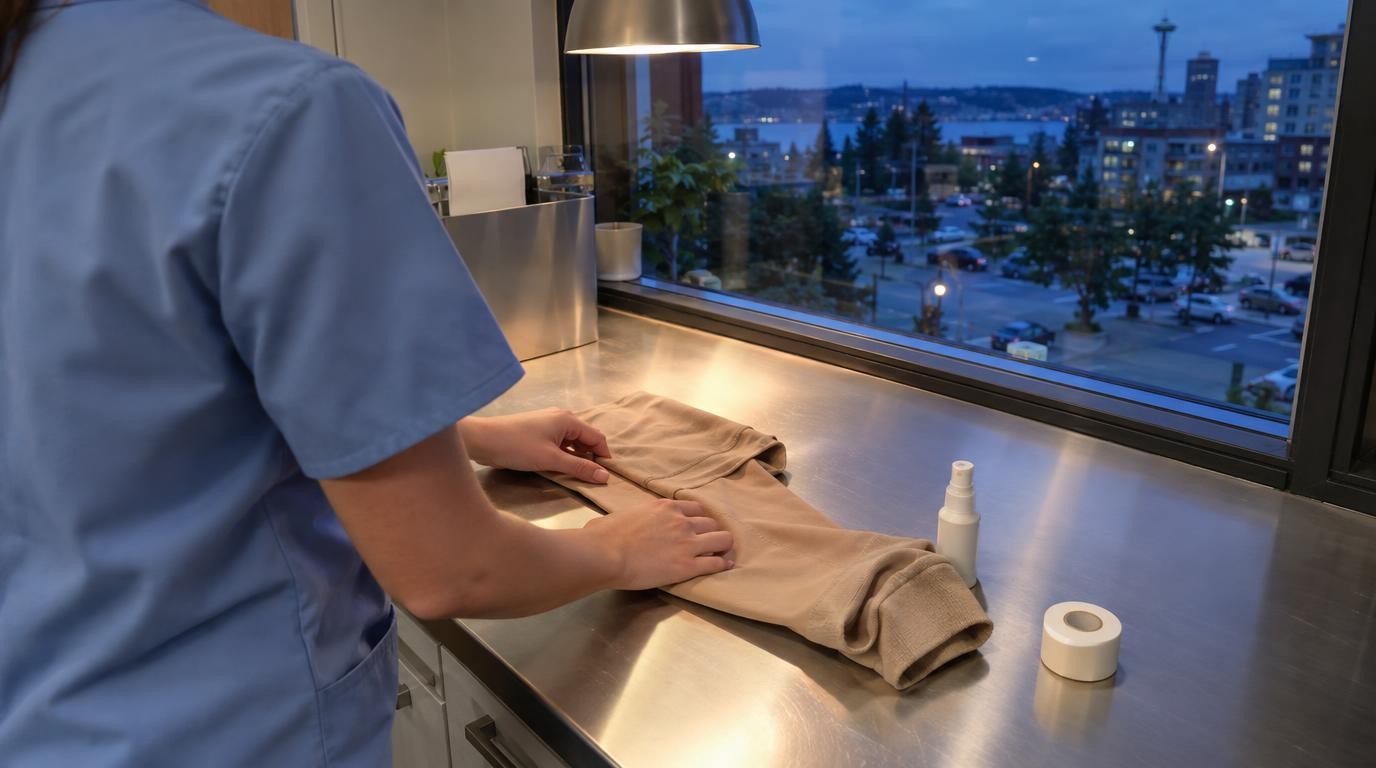
Cleveland Clinic says you’ll likely need to wear a thigh lift compression garment for at least six weeks. It supports healing and helps minimize swelling; follow your surgeon’s instructions for its fit and wear schedule.
When can you exercise after a thigh lift?
At La Belle Vie Cosmetics, return to exercise after a thigh lift is estimated at about six weeks, subject to surgeon clearance. Gentle movement during early recovery is different from running, heavy lifting, or a workout that pulls on healing incisions. Increase activity gradually according to your surgeon’s instructions, even if you feel ready sooner.
An exercise clearance date does not mean swelling has completely resolved. Walking around the house also places different demands on healing thighs than brisk walking, strength training, or sports.
Does the type of thigh lift affect recovery time?
A lower body lift addressing the outer thighs may have a shorter recovery than a full-length vertical thigh lift, which surgeons in an American Society of Plastic Surgeons article describe as having the most intensive recovery. Incision length, the area treated, and any additional procedure can change your plan. At La Belle Vie Cosmetics, an inner thigh incision may follow the groin crease or extend down the thigh, while an outer thigh lift addresses the hip and outer thigh.
Surgeons quoted in that American Society of Plastic Surgeons article describe these differences in recovery:
| Approach | Area or incision | Recovery consideration |
|---|---|---|
| Inner thigh lift | The incision may run along the groin crease or extend down the inner thigh. | A surgeon quoted by the American Society of Plastic Surgeons estimates six to eight weeks before most patients are comfortable with standard or brisk walking again. |
| Lower body lift addressing the outer thighs | Includes the outer thigh and hip area. | The American Society of Plastic Surgeons describes recovery of about three to four weeks for this approach. |
| Full-length vertical thigh lift | Uses a longer incision down the thigh. | The American Society of Plastic Surgeons describes this as the most intensive recovery; a surgeon it quotes advises strict leg elevation for two to three weeks. |
The incision’s location affects where wounds need care and where scars will remain. Our guide to inner thigh lift surgery and candidacy can help you explore that option.
What happens with a thigh lift?
Under general anesthesia, excess skin and fat are removed, and the remaining tissue is lifted and secured to improve thigh contour. At La Belle Vie Cosmetics, surgery typically takes two to three hours, depending on the technique and individual anatomy. The location and extent of the incision depend on where the loose skin is and how much needs to be removed.
If your concern is excess fat and your skin has enough elasticity to adapt to a new contour, liposuction alone may be an option. The American Society of Plastic Surgeons’ thigh lift guidance distinguishes that option from a thigh lift, which removes loose skin. When skin elasticity is poor, a thigh lift with liposuction may be recommended.
Does adding liposuction change the recovery plan?
It can. We may combine a thigh lift with liposuction for more refined contouring, but additional treatment can change the aftercare and activity plan. Discomfort, bruising, redness, and swelling are expected early after liposuction; the American Society of Plastic Surgeons’ liposuction recovery guidance says swelling usually starts to subside by the end of the first week, although some may last as long as six weeks. There is no established worst day for everyone, and liposuction-alone milestones should not be treated as the timetable for combined surgery. Some surgeons stage liposuction and a thigh lift rather than perform them together. Your surgeon will set the recovery plan for the procedures you have. A thigh lift may also be part of broader body contouring, such as a full body lift; its recovery plan must account for the full scope of surgery.
When do swelling, scars, and thigh lift results settle?
Thigh contours can look different soon after surgery, but swelling and scar changes continue beyond the return to daily activity. At La Belle Vie Cosmetics, results become clearer as swelling subsides, and scars typically fade over time. The American Society of Plastic Surgeons recovery guide notes that final results may take several months to develop and that visible scars remain.
Stable weight and a healthy lifestyle help support long-lasting results, although aging can change skin firmness. Expect improvement rather than a scar-free outcome or a fixed day when healing is complete.
What risks or health factors can change thigh lift recovery?
Complications after a thigh lift are not uncommon, but Cleveland Clinic says they are usually not serious. An American Society of Plastic Surgeons report on a series of 106 patients who had medial thigh lifts after major weight loss found some type of complication in 68% and a complication requiring additional surgery in 6%. The same ASPS report found complication rates of 43% after horizontal thighplasty, 64% after short-scar thighplasty, and 74% after full-length vertical thighplasty in that group. These figures are not rates for every thigh-lift patient.
Wound-healing problems and fluid buildup may require extra care; infection and blood clots are also potential complications. Mild swelling is expected early on: follow your surgeon’s instructions for managing it, and contact your care team about new, worsening, unusual, or otherwise concerning leg swelling. If you already have leg swelling, discuss it before surgery; the American Society of Plastic Surgeons notes that thighplasty can worsen it and, uncommonly, swelling can become chronic. Also contact your care team for fever or chills, an incision that is unusually sore to touch, pain that does not respond to medication, or a wound without significant healing in the first couple of weeks.
The American Society of Plastic Surgeons’ thigh lift safety guidance also identifies bleeding, wound separation, changes in sensation, unfavorable scarring, asymmetry, skin loss or fat necrosis, persistent pain, anesthesia risks, and possible revision surgery. Seek immediate medical attention for shortness of breath, chest pain, or an unusual heartbeat.
A thigh lift may be an option if you have loose or sagging inner or outer thigh skin, often after significant weight loss or aging. At La Belle Vie Cosmetics, we also consider stable weight, overall health, nonsmoking status, and realistic expectations. If you smoke, your weight is still changing, or you have a condition that may impair healing, ask us whether to postpone surgery or assess your risks individually rather than assuming these recovery estimates apply to you. Discuss your health history and medications with your clinician.
Frequently Asked Questions
Will I have drains after a thigh lift, and when are they removed?
You may have temporary drains after a thigh lift, depending on the procedure. Johns Hopkins Medicine describes one thigh lift approach with two drains removed one to two weeks after surgery.
When is the first follow-up visit after a thigh lift?
The first follow-up is often about a week after thigh lift surgery. Cleveland Clinic says the care team checks how the surgical site is healing at that visit.
Can a thigh lift reduce skinfold chafing?
It can if loose thigh skin rubs together and causes irritation. Removing the excess skin may relieve chafing, although the degree of improvement varies.
Are virtual thigh lift consultations available if I live far from Seattle?
Our virtual consultations are reserved for out-of-state patients or those who live more than several hours’ drive away. Contact our team to ask whether you qualify and how an in-person examination would fit into your surgical planning.
How long do thigh lift incisions take to heal?
Thigh lift incision sites should heal after about six weeks, according to Cleveland Clinic. Healing can vary, and the incisions may remain sensitive to movement, temperature, and touch.
What if I cannot resume exercise at six weeks?
Six weeks is an estimate, not a deadline. If pain, troublesome swelling, or incision-healing problems are holding you back, contact your surgeon before increasing exercise so your activity plan can be adjusted.
Can I go home the same day as my thigh lift?
You may go home the same day, but some patients need a hospital stay. Cleveland Clinic says the surgeon determines whether you can go home after surgery.
How can you plan a thigh lift recovery consultation in Seattle?
Bring your work schedule and details of the help available at home to your consultation. Our team can use them alongside your planned incision and any additional procedures to develop an aftercare plan covering activity, compression, incision care, and follow-up visits.
- Which movements or tasks should I plan help with at home?
- How will my job duties affect my return-to-work date?
- What healing checks must happen before I resume exercise?
- How should I use my compression garment and care for my incisions?
For a personalized plan, contact La Belle Vie Cosmetics in Seattle to arrange a consultation with Dr. Tony Mangubat, MD, a board-certified cosmetic surgeon. Call 206-575-0300 to discuss your goals and the recovery questions that matter most to you.
This information is general and is not medical advice. Talk to a licensed clinician about your own situation before making a treatment decision.
